A bowling bag is one of the few pieces of custom gear that has to survive being loaded to sixty pounds and dragged across a parking lot twice a week for years. The failure point is almost never the fabric panel your logo sits on — it is the wheels, the handle, or the strap, because those carry a load that most buyers underestimate until a wheel shears off in a league night crowd. If you are ordering custom bags for a league, team, or event, the smartest thing you can do before you pick colors is understand how heavy the finished bag actually gets and spec the hardware to match. Here is the weight math, and what it means for the parts that break.
The weight is mostly balls, and it climbs fast
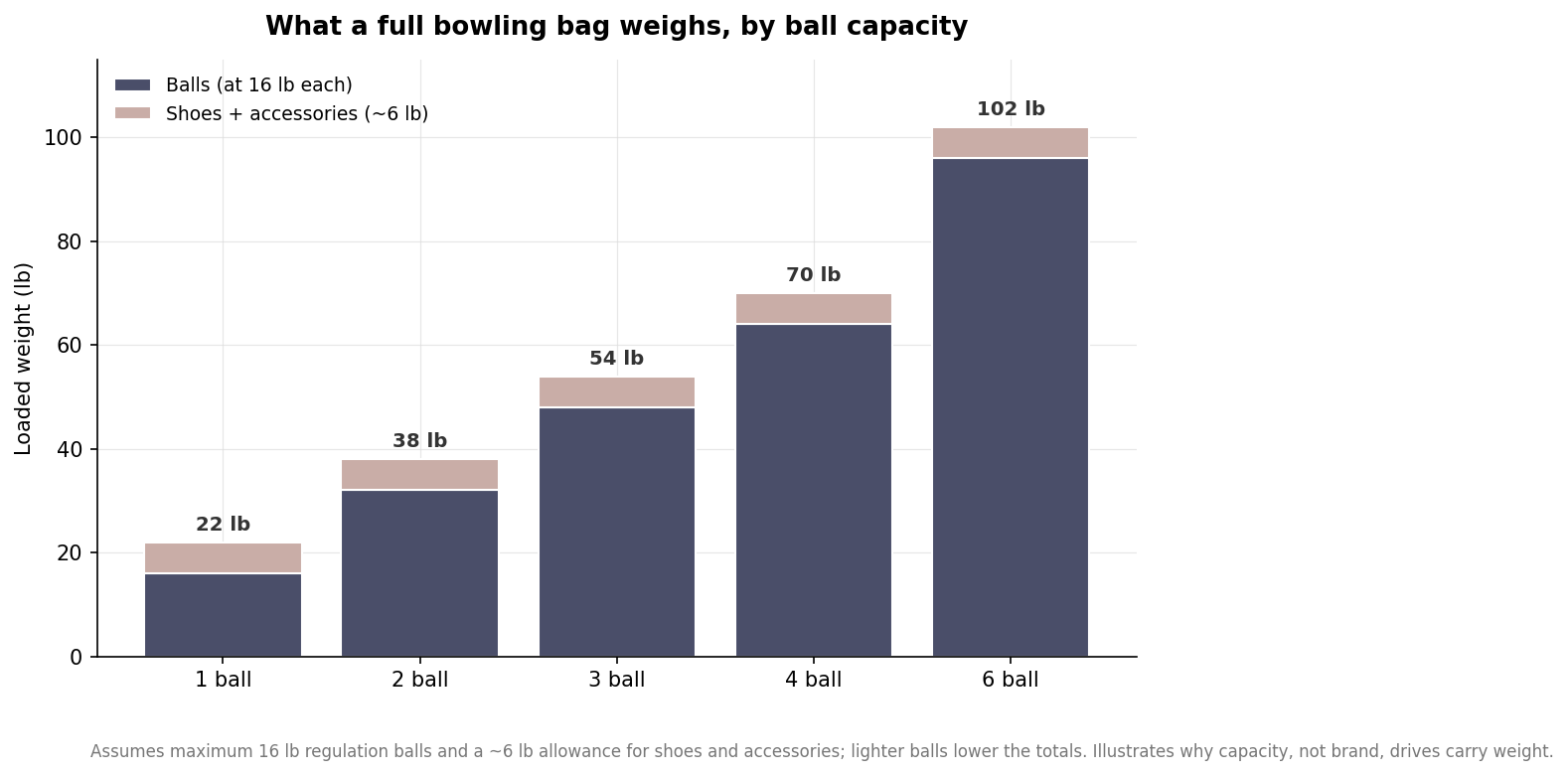
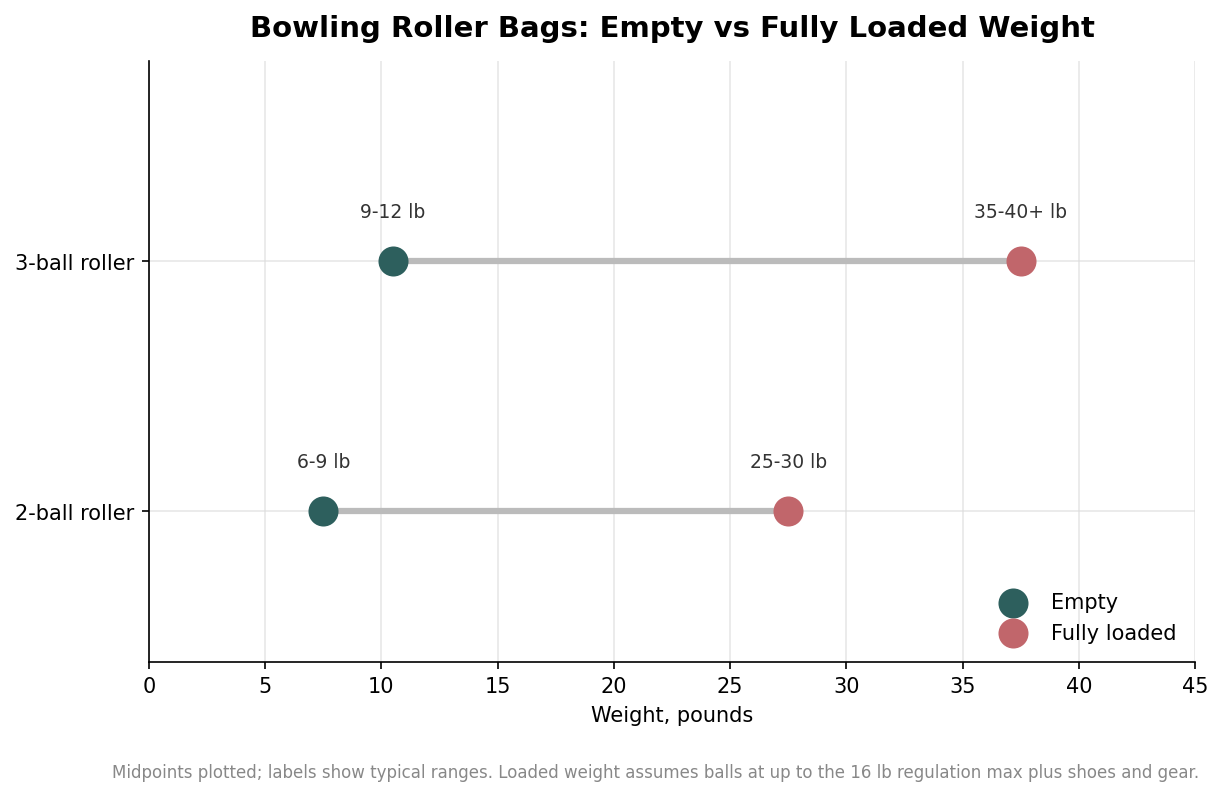
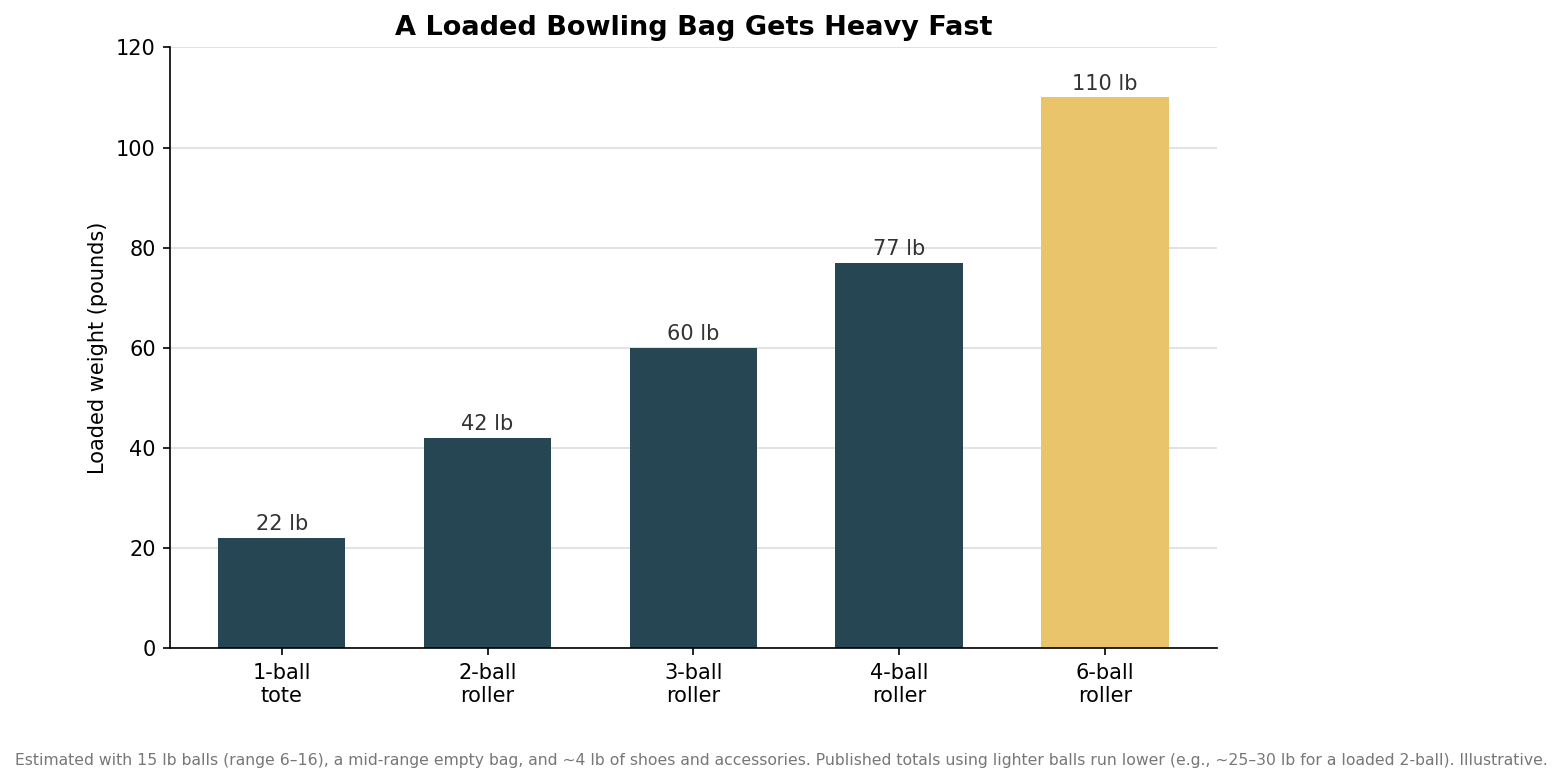
Bowling balls are dense. A regulation ball tops out at 16 pounds, and while youth and some adult players drop to the 6-to-14 range, league bags are usually packed with balls near the heavy end. Stack a few of those and the total moves quickly. Using a common 15-pound ball, a mid-weight empty bag, and about four pounds of shoes and accessories, a single-ball tote lands near 22 pounds, a two-ball roller around 42, a three-ball roller close to 60, a four-ball near 77, and a six-ball roller well past 100. Published figures that assume lighter balls run lower — a loaded two-ball is often quoted around 25 to 30 pounds — but the point stands: the moment you add a second or third ball, you are building a piece of rolling luggage in weight class, not a gym bag.
Where the pounds actually come from
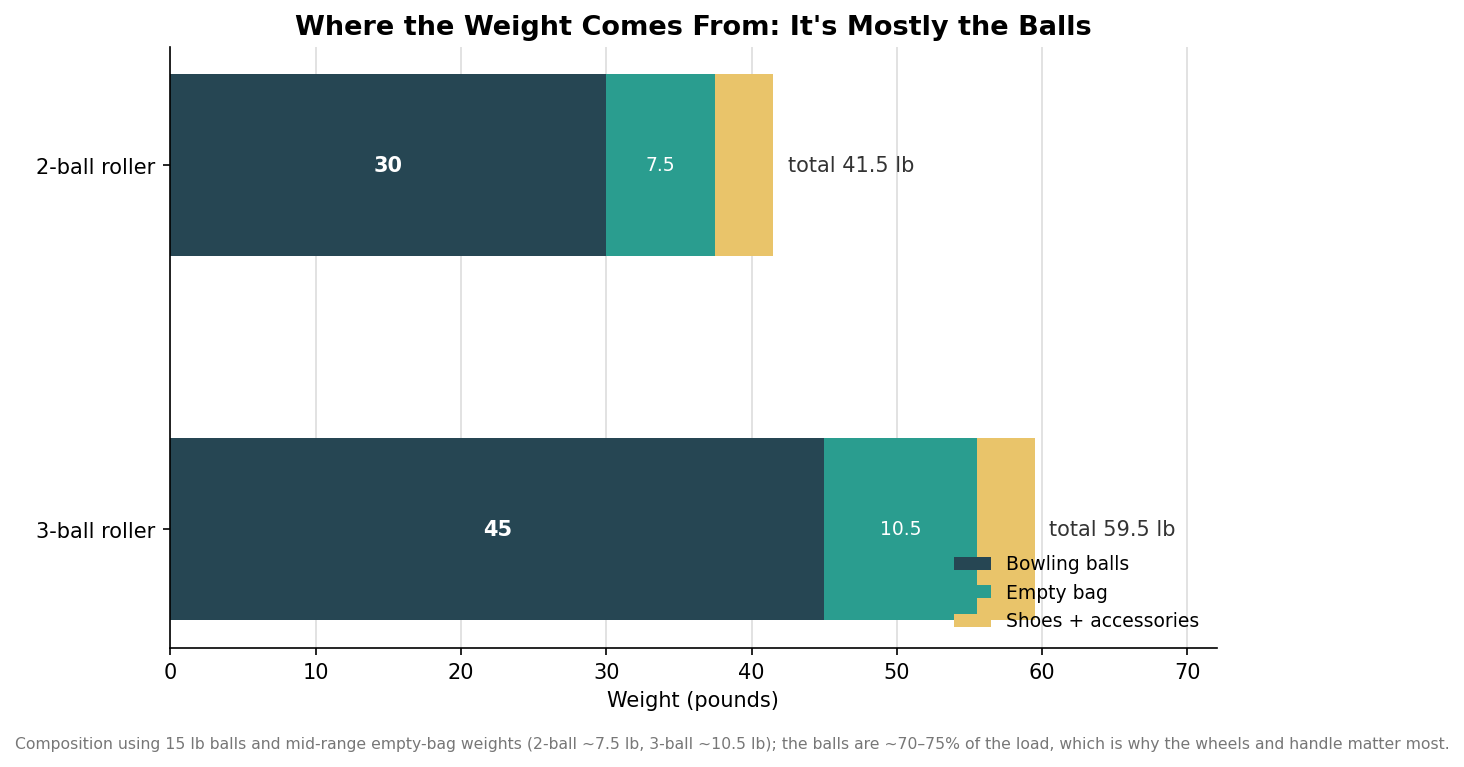
Roughly three-quarters of a loaded roller’s weight is the balls themselves. In a two-ball roller carrying two 15-pound balls, the balls are about 30 of the roughly 42 total pounds; in a three-ball, 45 of about 60. The empty bag adds single digits — a two-ball roller runs about 6 to 9 pounds empty and a three-ball about 9 to 12 — and shoes plus a wrist support, tape, and rosin add a few more. That distribution is the whole design lesson: because the mass is concentrated and low in the bag, every bit of it bears down on the wheels and the base when rolling and hangs off the handle when lifting curbs and stairs. You are not designing a bag that holds sixty pounds evenly; you are designing one that channels a dense, concentrated load through two small contact points.
The wheels and handle fail first
Because the load funnels through them, the rolling hardware is where quality separates. On premium bags the wheels are large — on the order of five inches — in urethane with real bearings, which roll over thresholds and gravel and resist flat-spotting under a parked load. Budget bags use small, hard plastic wheels that drag, crack, and seize, and a seized wheel under fifty pounds does not limp along — it stops you dead. The best bags make the wheels replaceable, acknowledging that they are the wear item. Handles tell the same story: an extendable steel handle with a positive locking mechanism, often extending past 40 inches, takes the shock of yanking a loaded bag up a curb, while a thin telescoping tube with a weak lock bends or collapses. When you compare sample bags, load them to their rated ball count and actually pull them over a curb; a spec sheet cannot tell you what a cheap wheel does at weight.
Fabric and base carry the abuse
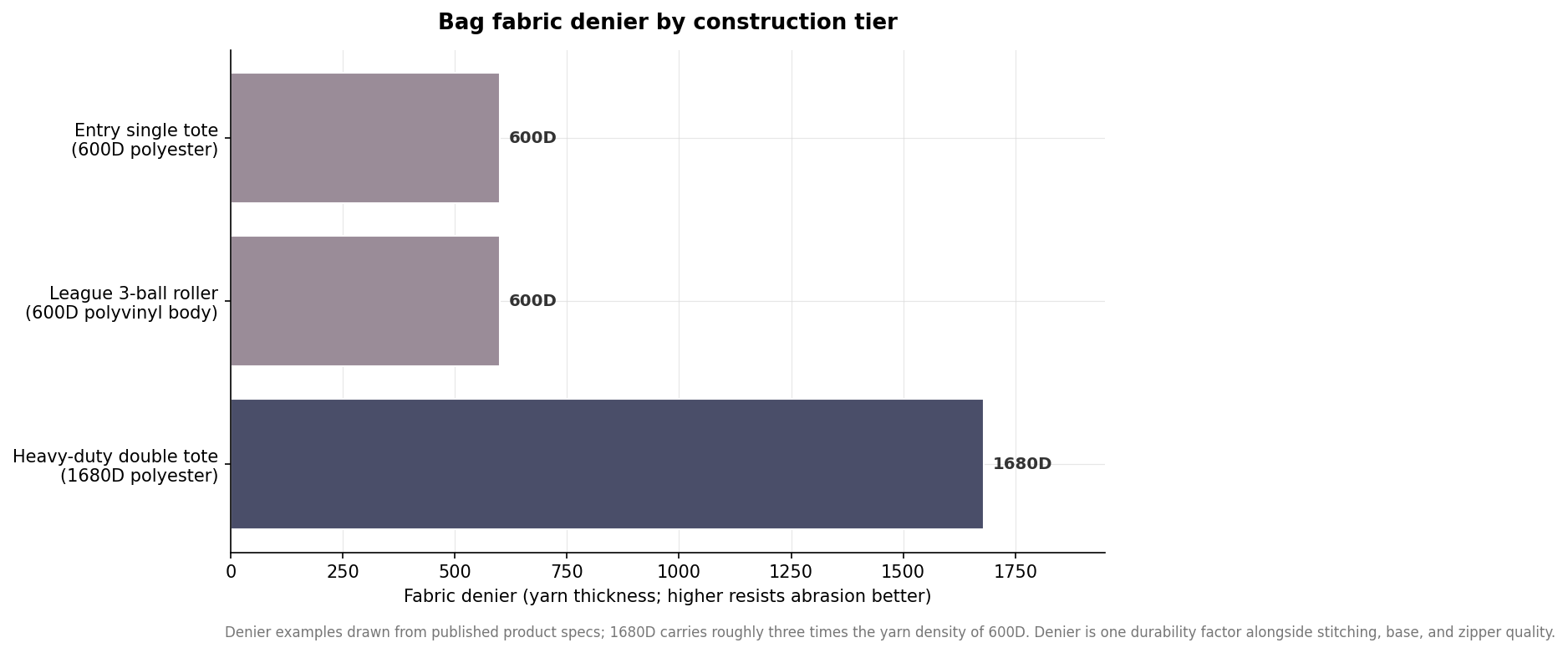
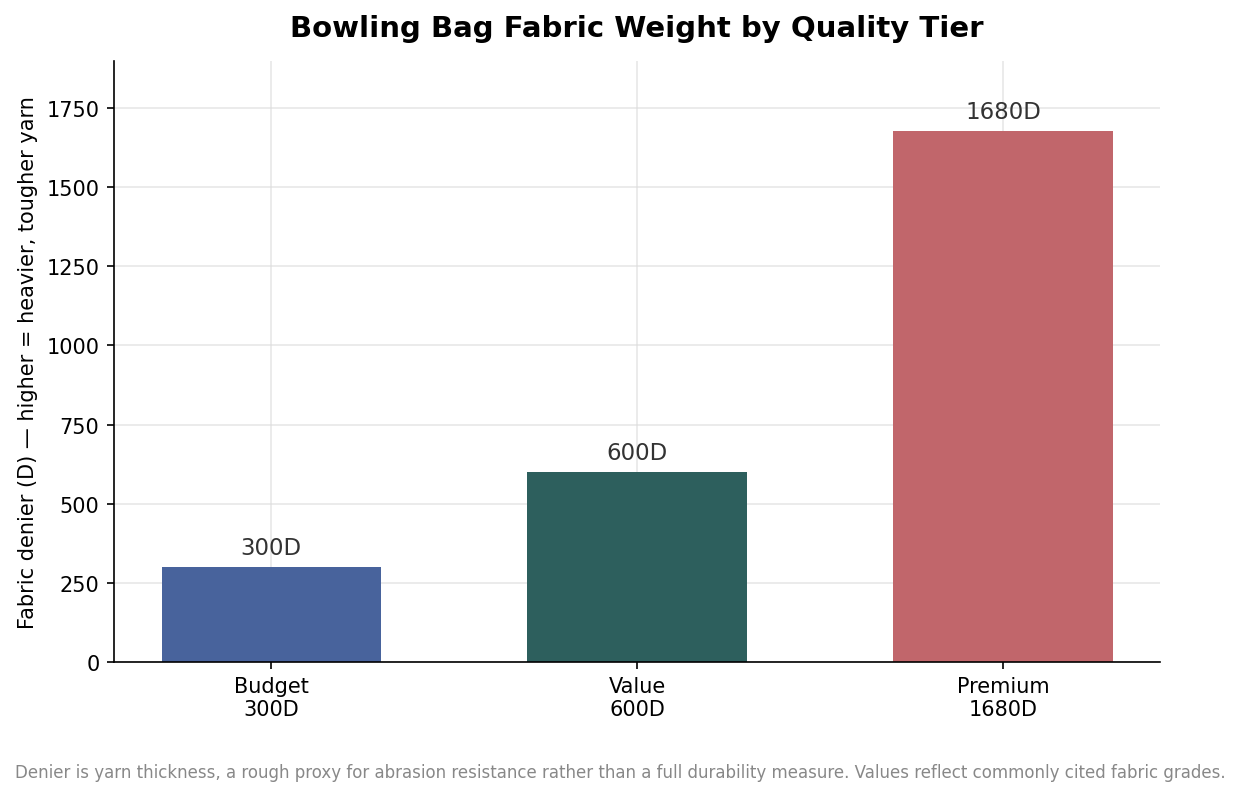
The panels matter less for your logo than for their toughness. Denier — the fabric’s thread weight — is the shorthand here: budget bags use thin 300-to-600D polyester, while premium bags use high-denier ballistic fabrics around 1680D that shrug off scuffing and abrasion. Just as important is a rigid base: a molded or reinforced bottom (some bags add a 5 mm impact-resistant board) keeps the balls from punching the fabric into the ground and gives the wheels a stable mounting point. Reinforced or YKK-grade zippers on the ball compartments are the other quiet failure point, since they are opened and closed under tension every session. None of this is visible in a product photo, which is exactly why it gets value-engineered out of cheap bags — and why buyers who spec only on price end up replacing bags every season or two instead of getting the five-to-seven years a well-built bag delivers.
Specifying a custom bag that survives its own load
Turn the weight math into a spec sheet. Start by matching the hardware to the real ball count: if your league bowlers carry three balls, do not accept the wheels and handle from a two-ball design carried over to a bigger shell. Call out wheel size and material, bearing quality, and whether wheels are replaceable; call out an extendable steel handle with a tested locking mechanism; call out fabric denier and a reinforced or molded base; and call out zipper grade. For any tote or backpack meant to be carried rather than rolled, pay attention to the strap and its anchor stitching, because a three-ball tote on a shoulder is fifty-plus pounds hanging from two seams — which is why three-ball capacity is usually a roller, not a tote, for good reason. Finally, ask about a warranty and a wheel-replacement path; a manufacturer willing to stand behind the rolling hardware is telling you they built it to take the load. Get those bones right, and the bag will still be rolling — with your logo intact — long after a cheaper one would have lost a wheel in the lot.