The right bowling bag is decided by two questions in order: how many balls you carry, and how you want to move them. Get the first wrong and the bag is either half empty or bursting; get the second wrong and you are hauling forty pounds by a shoulder strap across a parking lot. This guide walks the main bag types from a single-ball tote up to a six-ball roller, with the capacity, construction, and weight realities that separate them, so a league, a team, or an event organizer ordering in bulk can match the bag to how it will actually be used.
Start with how many balls, then how you’ll move it
Bowling bags sort cleanly by capacity: one, two, three, four, and six balls, with tote, backpack, and roller carrying styles layered on top. A casual bowler with one ball and a pair of shoes has very different needs from a tournament player traveling with a four-ball arsenal. Capacity also quietly sets the carrying method, because ball weight adds up fast. A regulation ball can weigh up to sixteen pounds, so the number of balls a bag holds is the single biggest driver of how heavy it gets when full, which is the reason bags stop being carried and start rolling somewhere around the two-to-three-ball mark.
Totes: one or two balls, carried by hand
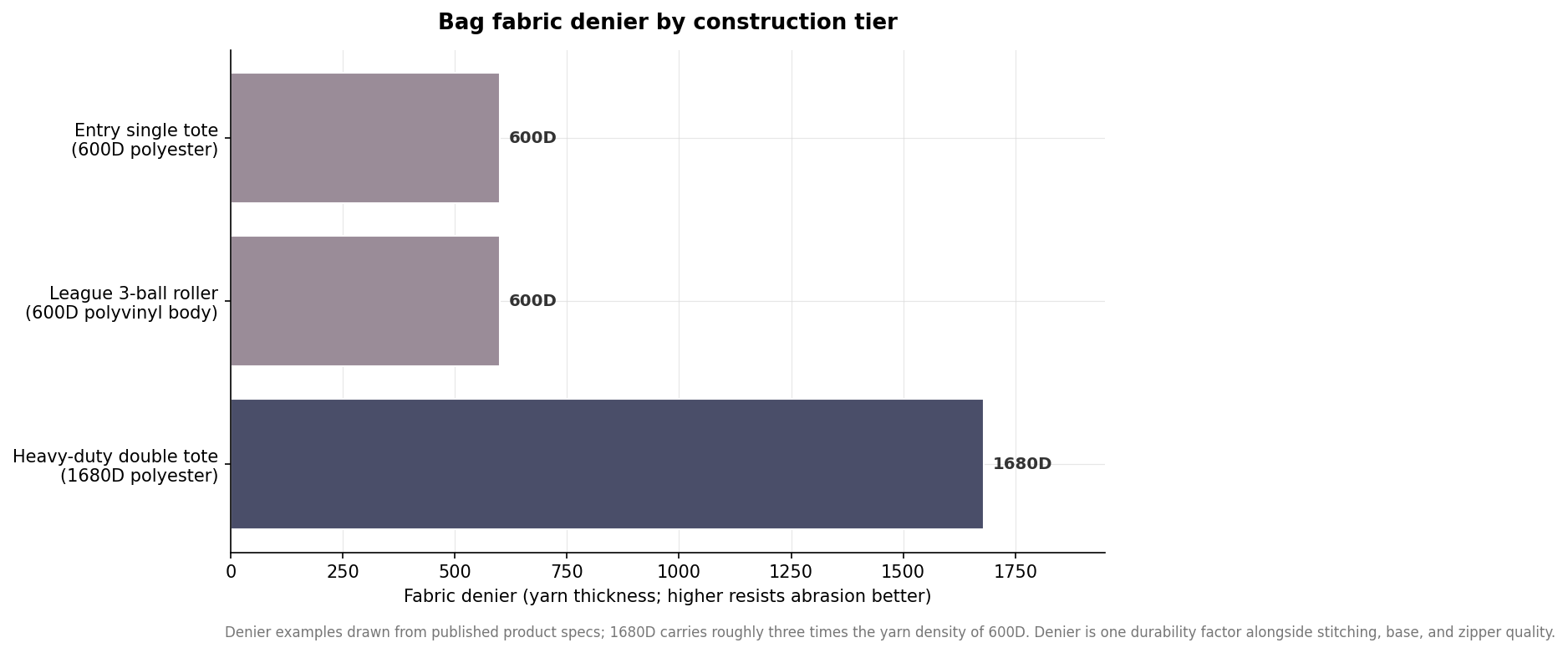
Single-ball totes are the entry point. A representative example carries one ball plus shoes up to about a men’s size 14, built from 600-denier polyester with a reinforced bottom and a vented shoe compartment to keep odor down. It suits casual and beginner bowlers who show up with one ball and leave. Two-ball totes are the league workhorse. A heavier example uses 1680-denier polyester, roughly three times the yarn density of standard 600D, with two zippered ball compartments and room for shoes. The tougher fabric adds weight and cost, but it is the difference between a bag that lasts a season and one that lasts many. Backpack-style bags occupy a similar one-to-two-ball range for bowlers who prefer to carry on both shoulders. Across all of these, the practical ceiling is comfort: two balls and shoes is about as much as most people want to carry by hand for any distance.
Rollers: three balls and up
Once you pass two balls, wheels stop being a luxury. A three-ball roller, often built on a 600D polyvinyl body with a collapsible telescopic handle, carries a league bowler’s working arsenal plus shoes and accessories. Standard wheels handle smooth center floors well but take more effort on carpet or gravel, so the wheel and axle quality matters more as the load grows. Four-ball rollers step up the frame accordingly; one example rides on a forged steel axle with five-inch, eight-spoke wheels and is rated for sixty-plus pounds fully loaded, which is the territory of multi-day tournaments and travel. Six-ball rollers extend the same idea for coaches, pro-shop staff, and serious competitors who need a full selection on hand. The larger the roller, the more the buying decision shifts from the bag body to the rolling hardware underneath it.
Do the weight math before you buy
It helps to see the load in numbers rather than guess. At the maximum sixteen-pound ball weight, plus a modest allowance for shoes and accessories, a full bag’s weight climbs steeply with capacity, as the chart below shows. A one-ball tote tops out around twenty pounds, a two-ball around the high thirties, and a four-ball roller comfortably clears sixty, which lines up with the load ratings makers publish for their heavier frames.
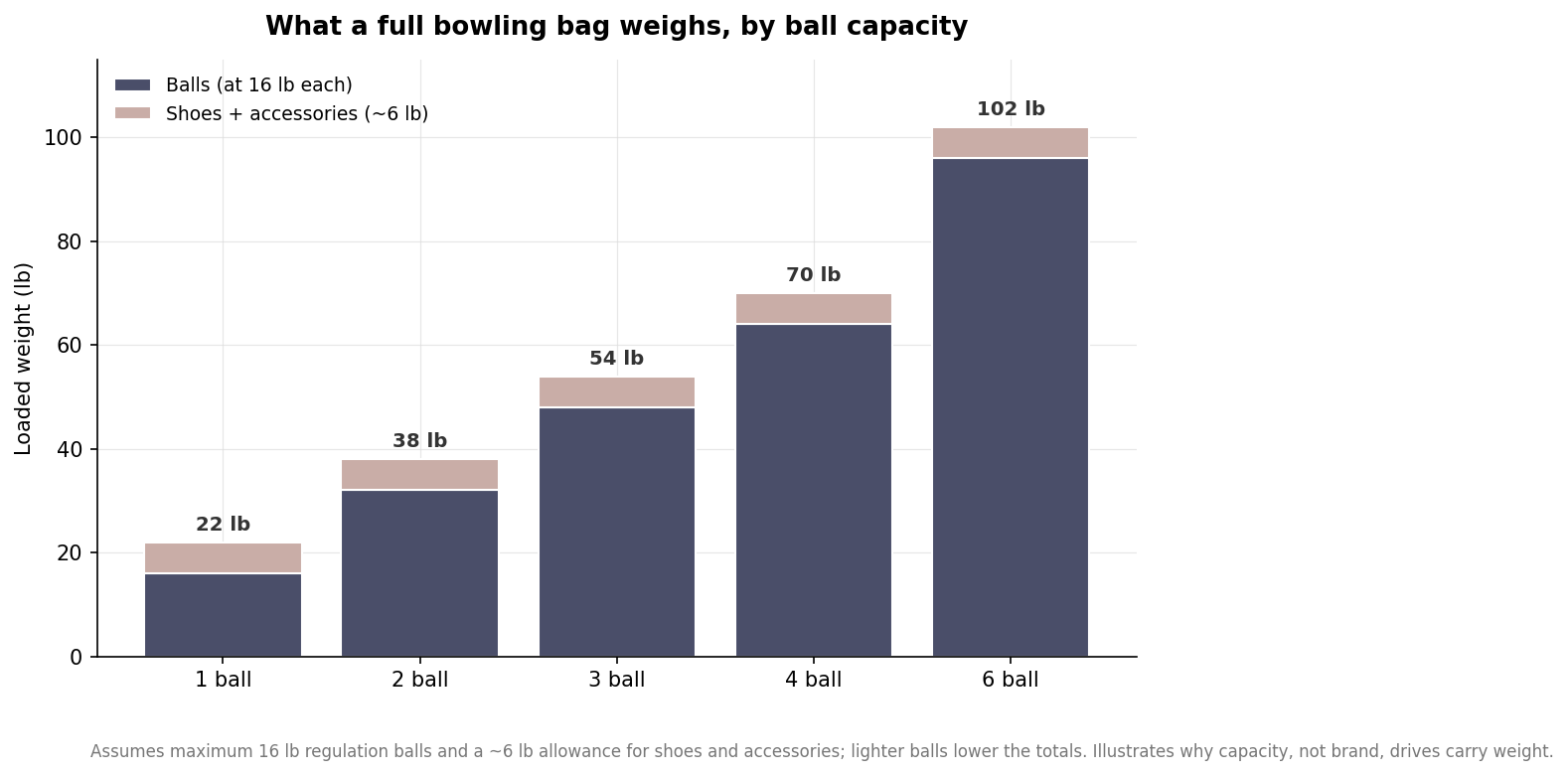
These totals are why carrying style tracks capacity so closely. The numbers assume every ball is at the regulation maximum, so a bag packed with lighter balls will weigh less, but the shape of the curve does not change: past two balls, a bag full of equipment is heavy enough that wheels and a sturdy handle are doing real work. When you order for a group, it is worth matching bag capacity to what people genuinely carry rather than the largest size available, because an oversized roller invites overpacking and the extra weight lands on the wheels and the bowler.
Wheels, handles, and fabric that survive the season
Durability lives in three places: the fabric, the base, and the rolling hardware. Fabric is measured in denier, the yarn thickness, and higher numbers resist abrasion better. The chart below compares documented examples, from 600D on entry and league bags to 1680D on heavy-duty totes. Denier is not the whole story, though; reinforced stitching, a molded or reinforced base that takes the impact of being set down loaded, and quality zippers matter just as much, and a bag is only as strong as its weakest seam.
On rollers, the wheels and handle are the parts that fail first if they are undersized. Larger wheels roll more easily over thresholds and rough ground, a spoked or reinforced wheel resists bending under a heavy load, and a forged axle outlasts a stamped one. A telescopic handle should lock firmly at height and not wobble under a full bag. For teams and leagues ordering branded bags, the fabric choice also shapes decoration: high-denier ballistic-style panels take embroidery cleanly on a stabilized flat area, and a sewn patch or printed panel carries a team or event name without stressing a zippered compartment. Choose the capacity for the arsenal, the carrying style for the weight, and the hardware for the miles, and a single bag design can serve a whole roster for years rather than a single season.