A custom bowling bag is one of the more satisfying pieces of team gear to order, because it gets used every week and it carries your name into every center you visit. It is also easy to get wrong in ways that only show up after the boxes arrive. Most of the regret comes from a handful of predictable mistakes that have nothing to do with the artwork and everything to do with how the bag is built and sized. Here is what trips people up, and what to confirm before you approve a bulk order.
Sizing for the wrong number of balls
The single most common error is buying a bag for the balls a bowler owns today rather than the balls they will carry. Casual league players are usually fine with a one or two-ball bag, but a bowler who chases different lane patterns will want three, and tournament and travel players routinely move up to four and six-ball arsenal cases. If you are ordering for a whole team, resist the urge to standardize on the smallest bag to save money. A player who has to leave a ball at home every week will quietly resent the gift. The jump from a two-ball to a three-ball bag is small in price and large in usefulness, so when a bowler is on the fence between sizes, the larger bag is almost always the safer order. Ask the group what they actually carry, then size to the heavier users.
Underestimating loaded weight and the rolling hardware
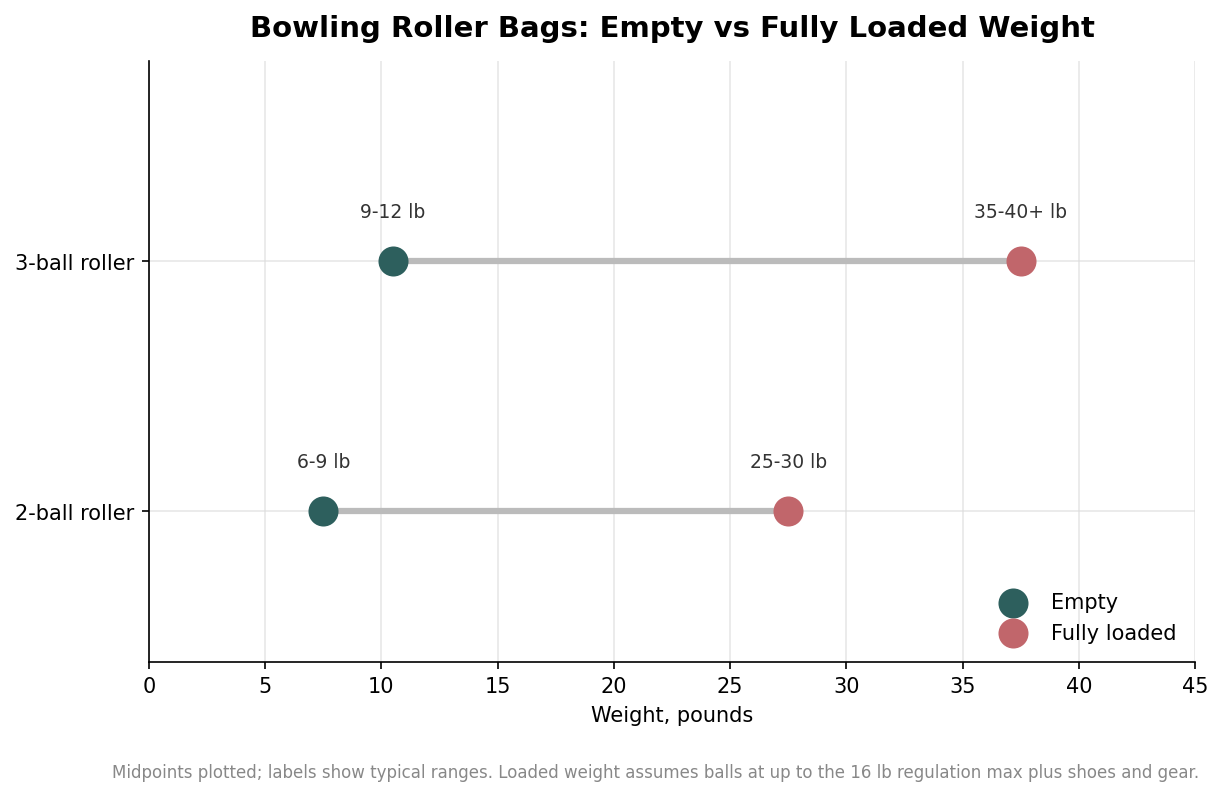
Regulation bowling balls run up to 16 pounds, and that weight adds up fast. A two-ball roller that weighs six to nine pounds empty commonly reaches 25 to 30 pounds once it is loaded with balls, shoes, and accessories. A three-ball roller that starts at nine to twelve pounds empty can hit 35 to 40 pounds or more. The chart below shows how far the loaded figure jumps from the empty one, which is the number people forget when they picture carrying the bag.
That loaded weight is exactly why the wheels and handle matter more than the color. On a bag that will be dragged across parking lots and up center steps, look for large urethane wheels in the range of five inches with real bearings, an extendable steel handle with a locking mechanism, and a rigid molded base so the bag does not sag onto its own wheels. Heavy-duty zippers, the YKK-grade or reinforced kind, are the other quiet failure point; a blown zipper on a loaded three-ball bag is a bad night. None of this shows in a photo, so it belongs in your spec, not your assumptions.
Skimping on the fabric and base
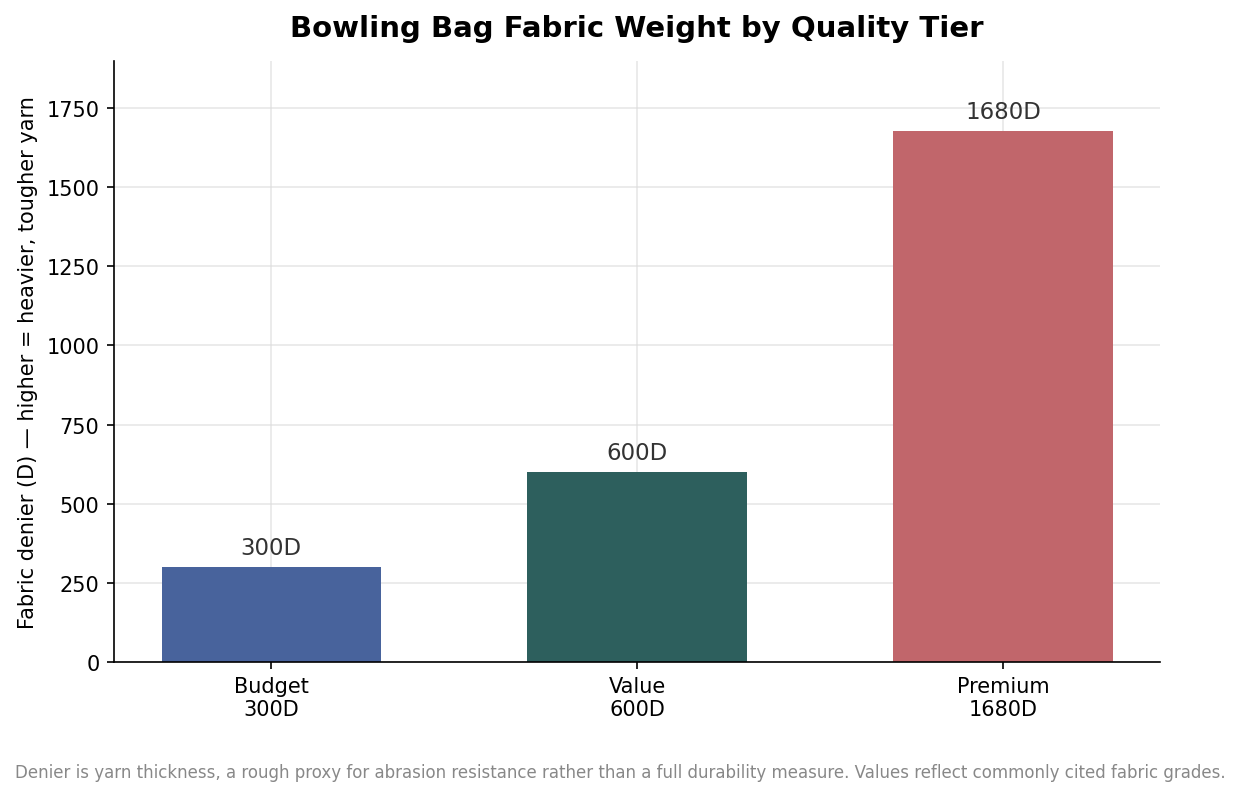
Cost pressure usually lands on the fabric, and it is the wrong place to cut. Budget bags are often built from thin 300 to 600 denier polyester, while durable bags use high-denier ballistic fabrics around 1680D. Denier is simply the thickness of the yarn, so a higher number generally means better resistance to the scuffs and drags a bowling bag lives through. It is not a complete measure of quality, but the gap between a 300D shell and a 1680D shell is the difference between a bag that frequently fails within a season or two and one that often lasts five to seven years or more.
For a branded bag this is not just a durability question, it is a brand question. Your logo is on the side of that bag for its whole life. If the shell frays and the base collapses after a season, the failing product is wearing your name. Spending a little more on the fabric and base protects the impression your brand makes every time the bag rolls into a center.
Treating the decoration as an afterthought
Bowling bags are usually branded with embroidery, and embroidery on a dense ballistic shell has its own rules. Tightly woven, heavy fabric needs proper stabilizer behind the stitch or the design will pucker, and fine detail or small text does not hold up well at small sizes. A clean, bold mark with limited fine detail reads far better across the room than a busy logo crammed into a small hoop. If your artwork has thin lines, gradients, or tiny lettering, plan to simplify it for stitching, or use an embroidered patch or a printed panel where the design allows more detail. Confirm the exact placement, size, and thread colors on a physical proof before the run, because a logo that looks fine on screen can sit awkwardly against a seam or a zipper on the real bag.
Forgetting the details that get used every week
The features that make a bag pleasant are easy to overlook on a spec sheet. A separate shoe compartment keeps damp soles away from equipment and is standard on most roller models, but not all, so check. Accessory pockets, a towel loop, and a comfortable top grab handle for lifting the bag into a trunk all matter to the person carrying it. And give yourself time: custom bags with embroidery are typically produced at order minimums in the low dozens to low hundreds and run a few weeks in production plus freight, longer around league startup season when factories are busy. Approving a single pre-production sample and building in that lead time is the cheapest insurance you can buy against a bulk order that arrives wrong. Get the capacity, the hardware, the fabric, and the decoration right, and the bag becomes the piece of team gear people are genuinely glad to carry.